DREO Whole-Room Heater 720 Review: The Top Rises
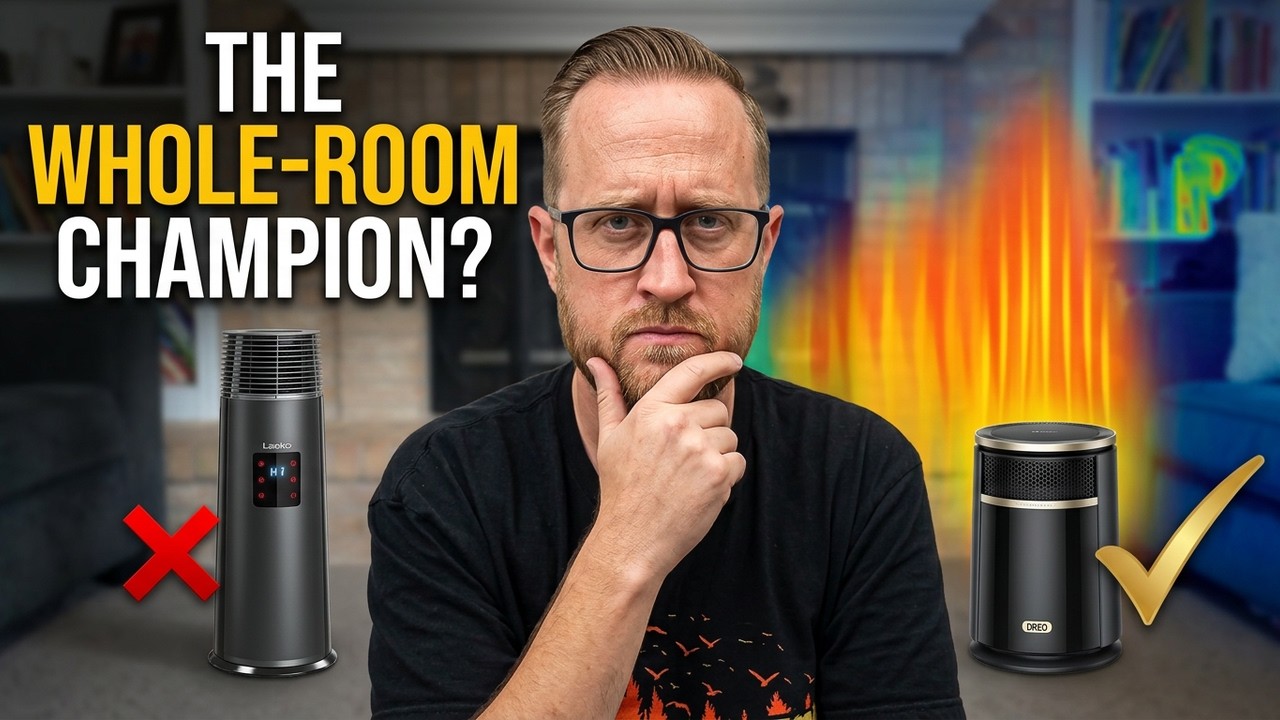
Most space heaters warm whoever is sitting in front of them. This one lifts its own top section to redirect the air through a full circle. I ran it against a Lasko oscillating tower through a Colorado October, with a thermal camera and a lot of ribbon.
https://www.youtube.com/watch?v=RKBz95d-9kk
THE VERDICT
If you want to warm one spot — a desk, a chair, the corner of a garage — an oscillating tower like the Lasko does that job and it is a known quantity. If you want the room warm, with nobody stuck on the cold side of it, the DREO Whole-Room Heater 720 is the one I would buy. The rising airflow is not a gimmick; it is the reason the heat reaches the far corners instead of sweeping an arc. The eight layers of Shield360 are why I am relaxed about leaving it running in a house with kids in it.
Every winter the same argument plays out in our living room. The heater goes in, somebody claims the couch directly in front of it and is quickly too warm, and somebody else is on the recliner six feet away with a blanket, quietly losing. The heater is not faulty. It is doing exactly what it was built to do, which is push hot air in one direction. The problem is that a room is not a direction.
The DREO Whole-Room Heater 720 is the first one I have used that treats that as the actual problem to solve, and the way it solves it is strange enough that it takes a second look to believe.
The top of the heater physically rises
DREO calls it AutoShift 360. In focused mode the unit behaves like any other ceramic heater, pushing warm air forward. Switch it to whole-room mode and a motorised assembly lifts the entire top section of the housing. That change in geometry is the whole trick: raising the lid opens a gap that redirects the airflow from a forward push into a full circle.
I did not take that on trust from a spec sheet. I taped lengths of ribbon around the top edge and ran both modes. In focused mode a few ribbons on one side lift and the rest hang still. In 360 mode the lid rises and every ribbon lifts at once — air leaving in all directions simultaneously, rather than touring the room one slice at a time.
It is an odd thing to watch a heater do, and as far as I can tell it is the entire reason this one works.
An oscillating tower solves it differently, and less well
The Lasko 24-inch tower I ran alongside it takes the conventional approach: the whole body swings side to side, so over the course of a minute the heat has visited most of the arc in front of it. If you are sitting inside that arc you will be warm. If you are outside it, you wait your turn, and you feel the warmth arrive and leave again.
That is the practical difference between sweeping an arc and filling a volume. It is not a knock on the Lasko, which does what it was designed to do. It is a different design goal.
What the thermal camera showed
Both units heat up quickly. PTC ceramic elements generally do, and DREO's Hyperamics element is no exception — there is no meaningful wait on either.
The interesting part was not how fast the temperature climbed, it was the shape of the heat. On thermal, the DREO builds a column that spreads outward and fills the space around it. The Lasko's heat signature tracks left and right with the oscillation, warming where it is currently pointed and cooling again where it is not. That is the whole argument, visible in false colour.
The bedroom is the harder test
Living rooms are easy to impress. Bedrooms are where space heaters get unplugged and put in a cupboard, because they are too loud, or they overshoot and cook you at 2am, or they glow like a landing strip all night.
This one is quiet enough to sleep through. The remote sets the temperature in single-degree steps from the bed and it will hold that figure all night rather than cycling hard between too hot and too cold — which is how I actually run it. And the RGB status ring, which is genuinely useful during the day for reading the room temperature at a glance, switches off completely. That is a small feature on a spec sheet and an enormous one at three in the morning.
Power settings and what it costs to run
There are three heat settings topping out at 1500W, plus an ECO mode that is the more useful control of the two. Rather than running flat out and then shutting off, ECO modulates output to hold the comfort level you set. DREO claims up to 40 percent energy savings against running at maximum.
For comparison, the Lasko CT24362 also offers three heat settings across a 750W to 1500W range.
The underlying logic is the one that justifies owning a space heater at all. Heating the room you are actually sitting in, to the temperature you actually want, costs less than heating an entire house to rescue one cold person on a recliner.
Eight layers of protection, two of which I put my hands on
We have kids, so this was the part I cared most about. DREO bundles its protections as Shield360: 45-degree tip-over shutoff, overheat protection, a child lock, cool-touch housing, an Anti-Scald Plug, thermal insulation, V-0 flame retardant materials, and ETL listing.
Two of those are worth more than a bullet point. The child lock is a two-button hold — the display counts down and shows LOCK, and from that moment nobody is changing the settings, which is the entire point in a house where the controls sit at toddler height. The cool-touch housing I tested with my palm flat against the side while the unit was running at full heat.
One honest caveat, because it is better said than discovered. Reach into the grille where the focused heat exits and it is hot, as it would be on any ceramic heater. The housing you would brush past walking through the room is not.