UREVO SpaceWalk 5L Review: The Incline Is The Point
Most walking pads give you a flat belt and a step counter. This one tilts to a nine percent grade, which changes what a fifteen-minute break is actually worth.
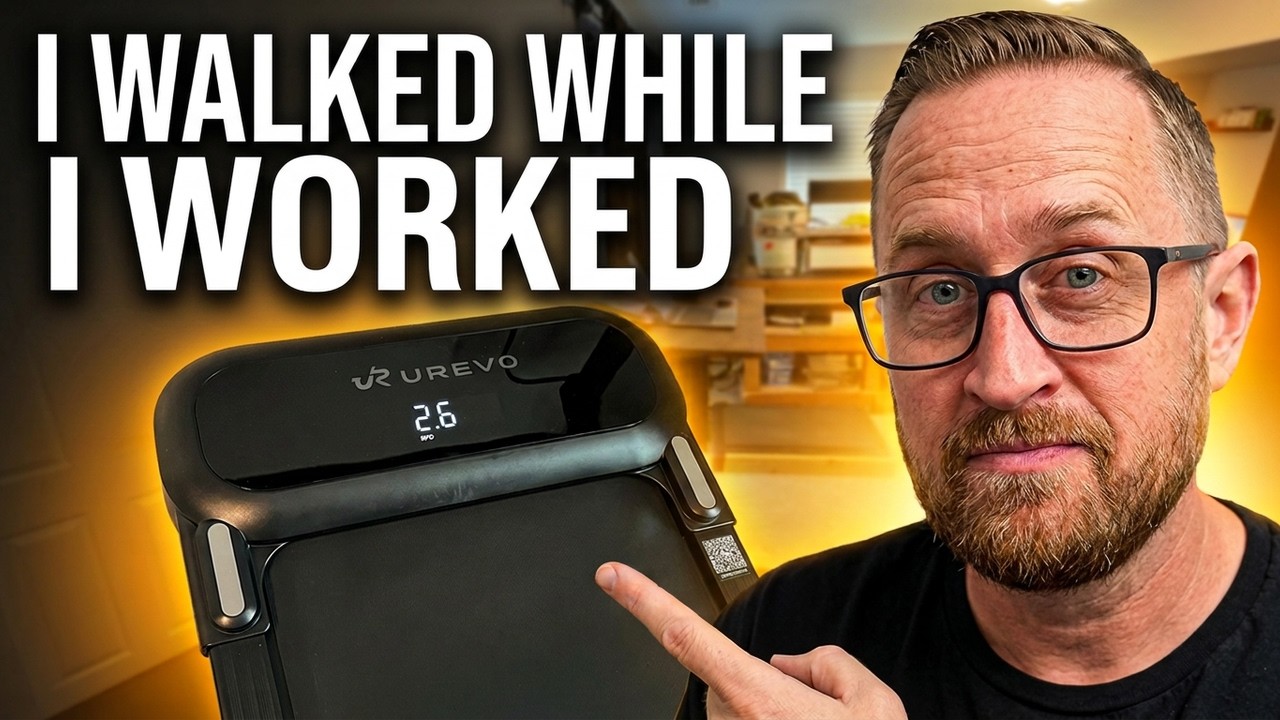
https://www.youtube.com/watch?v=PC9Qb46G1xE
THE VERDICT
If you want steps while you work, almost any walking pad will do. The SpaceWalk 5L earns its place by tilting: nine levels of incline up to roughly a nine percent grade, which turns a flat shuffle into something your legs actually notice. It is quiet enough that nobody on a video call knew it was running, and it rolls against a wall when it is done. The one real caveat is height — at 6 feet 4 the deck is short enough that a long stride occasionally reaches the back of it.
I work from home, which sounds like it should be good for staying active and is the opposite. The day is two fifteen-minute breaks and a half hour in the middle. That is not enough time to drive to a gym, park, change, do anything useful and come back. Some days it is barely enough time to get to the gym at all.
What it is enough time for, it turns out, is a steep walk. That is the thing the UREVO SpaceWalk 5L does that the walking pad category mostly does not.
The incline is the feature
Most under-desk treadmills are a flat belt and a number that goes up. The SpaceWalk 5L raises its deck through nine levels, topping out at around a nine percent grade. Press the plus button and the front of the machine lifts under you.
The difference is not subtle. A flat walking pad at two miles an hour is something you stop noticing after a minute, which is the whole appeal — it disappears under the desk while you answer email. Put it at the top of its range and the same two miles an hour becomes a hill. Fifteen minutes of that is a different fifteen minutes.
UREVO's own figure is that the incline and the interval programs together can lift calorie burn by as much as 190 percent over flat walking. I have no way to verify a number like that in a house, and I would treat it the way you treat any manufacturer's best case. What I can say is the one thing that matters to whether you keep using it: uphill, a short break feels like it counted.
If you hike, this is the part to pay attention to. Training for a trail with hills on a flat belt does very little. Nine percent for twenty minutes before a trip is the kind of thing that shows up later.
Quiet enough to take a call on
The spec is about 35 decibels at a walk, from a 2.5 horsepower dual brushless motor. The practical version of that figure is that I have taken conference calls while walking on it and nobody on the other end has mentioned a noise, or asked what I was doing, or heard anything at all.
That is the bar for a machine that lives in a home office. A walking pad you have to stop using every time someone calls is a walking pad you stop using.
Underneath, the deck is suspended with silicone shock absorption rather than bolted flat to the frame. The effect is less jarring through the knees than walking the same distance on pavement, which is the comparison that matters if you are adding steps rather than replacing a run.
Where it actually goes in the house
Two places, mostly. Under the standing desk, where it handles email and calls. And in front of the TV, where an episode becomes a walk instead of an hour on the couch. Both of those are time that was already being spent — the pad does not ask for a new slot in the day, it just changes what happens during one you already had.
When it is done it folds and rolls on its front wheels. Ours lives against a wall, which is the only reason it gets used as much as it does. A machine you have to drag out of a closet is a machine that stays in the closet.
The display and the app
The deck's own display cycles through steps, incline, speed, distance, time and calories, so you can run the whole thing without a phone if you want to.
The app is where it gets more interesting. Quick Start begins at 0.6 miles per hour deliberately — slow enough that stepping on is not an event — and a slider takes it up to four, which at the top is a light jog rather than a walk. Incline is a second slider. Stopping ramps you down rather than cutting out, which sounds like a small thing until you have stepped off something that did not.
There is a library of built-in sessions: a forty-minute steady fat-burn walk, a thirty-five-minute interval version, rhythm workouts that run to music, and HIIT programs that drive speed and incline for you. The point of these is less the programming than not having to decide anything. Press one, walk.
World Tour is sillier than it sounds and better than it should be
World Tour plays footage of a real route on the phone, turning it landscape, and walks you through it. I did an Iceland waterfall run. There are others — Wyoming, Colorado Springs.
It is a gimmick. It is also the thing that got me through a session I would otherwise have cut short. Prop the phone somewhere you can see it and twenty minutes of cardio stops being twenty minutes of staring at a wall. For anyone whose problem with a treadmill is boredom rather than effort, this is a bigger deal than the spec sheet suggests.
What it tracks
Time, distance, calories and an energy score per session, then averages rolled up by week, month and year. It syncs to Apple Health, so it lands in the same place as everything else rather than stranded in its own app.
The trend view is the part that is genuinely useful over weeks. A single session tells you nothing. Watching the weekly average drift up or down tells you whether to push or back off, and it is honest about the days you did very little.
The catch: it is short if you are tall
I am 6 feet 4. I can get a full stride on this, but when I really open up my back foot sometimes finds the rear of the deck. It has never been dangerous and it has never made me stop, but I notice it, and I would not have noticed it at six foot.
If you are tall and you intend to run on it rather than walk, measure before you buy. If you are average height, or you are buying it to walk — which is what a walking pad is for — this will not come up.
Who it is for
Anyone who sits for a living and has noticed their lower back keeping score. The honest pitch is not that this replaces the gym. It is that the gym keeps not happening, and this is in the room.
The incline is what separates it from the pile of flat belts at the same sort of price, and the quiet motor is what makes it survive contact with a working day. Those two things together are the review.